

Dual Bands Radio Manufacturer A Complete Guide to Choosing the Right Partner
2026-10-30
Every procurement manager knows the frustration: two dual bands radio suppliers list the same frequency range, power output, and ruggedness specs, yet one fails in the field within months while the other keeps your team connected for years. Choosing the right dual bands radio manufacturer is less about flashy brochures and more about asking the right questions before you commit. With hundreds of OEM and ODM options flooding the market, it’s easy to overlook long-term issues like firmware support, spare part availability, and real-world RF performance. This guide strips away the marketing noise to help you evaluate manufacturing partners on the criteria that actually matter. Along the way, you’ll see why a proven partner such as lisheng stands out—not through claims, but through a track record of consistent delivery and transparent engineering.
Reading the RF Front-End Beyond the Datasheet
Most engineers start with the datasheet when selecting an RF front-end module, but those pages only tell part of the story. The printed specifications—gain, noise figure, linearity—are measured under specific conditions that rarely match your actual operating environment. A low-noise amplifier might look stellar on paper yet fall apart when driven by a real antenna with a poor voltage standing wave ratio. The key is to treat the datasheet as a starting point, not a conclusion, and then dig into how the device behaves under mismatch, temperature swings, and varying supply voltages. Those second-order effects often determine whether a design works in the field or only on the bench.
Another layer that datasheets rarely capture is the interaction between the front-end and the surrounding circuitry. A power amplifier’s efficiency can drop dramatically when its load impedance shifts due to board parasitics or antenna detuning. Likewise, the receive chain’s sensitivity is not just a function of the LNA’s noise figure but also of the matching network losses and the local oscillator’s phase noise bleeding into the mixer. To read beyond the datasheet, you need to simulate the full signal path with realistic models—including package parasitics, trace lengths, and even the solder mask thickness. Only then do you see how the front-end truly performs as part of a system, not as an isolated component.
Finally, seasoned RF designers pay close attention to manufacturing variation, which datasheets often summarize with a single “typical” value and maybe a min/max range. But the distribution shape matters: a front-end with a wide spread in input return loss can cause inconsistent production yields, even if the average performance looks fine. Building a small batch of prototypes and characterizing them across temperature, frequency, and bias points reveals the corners where the front-end misbehaves. This empirical approach—combined with a healthy skepticism of any spec that seems too good to be true—is what separates a robust RF design from one that only works in a controlled lab.
Firmware Stability Across Temperature and Interference
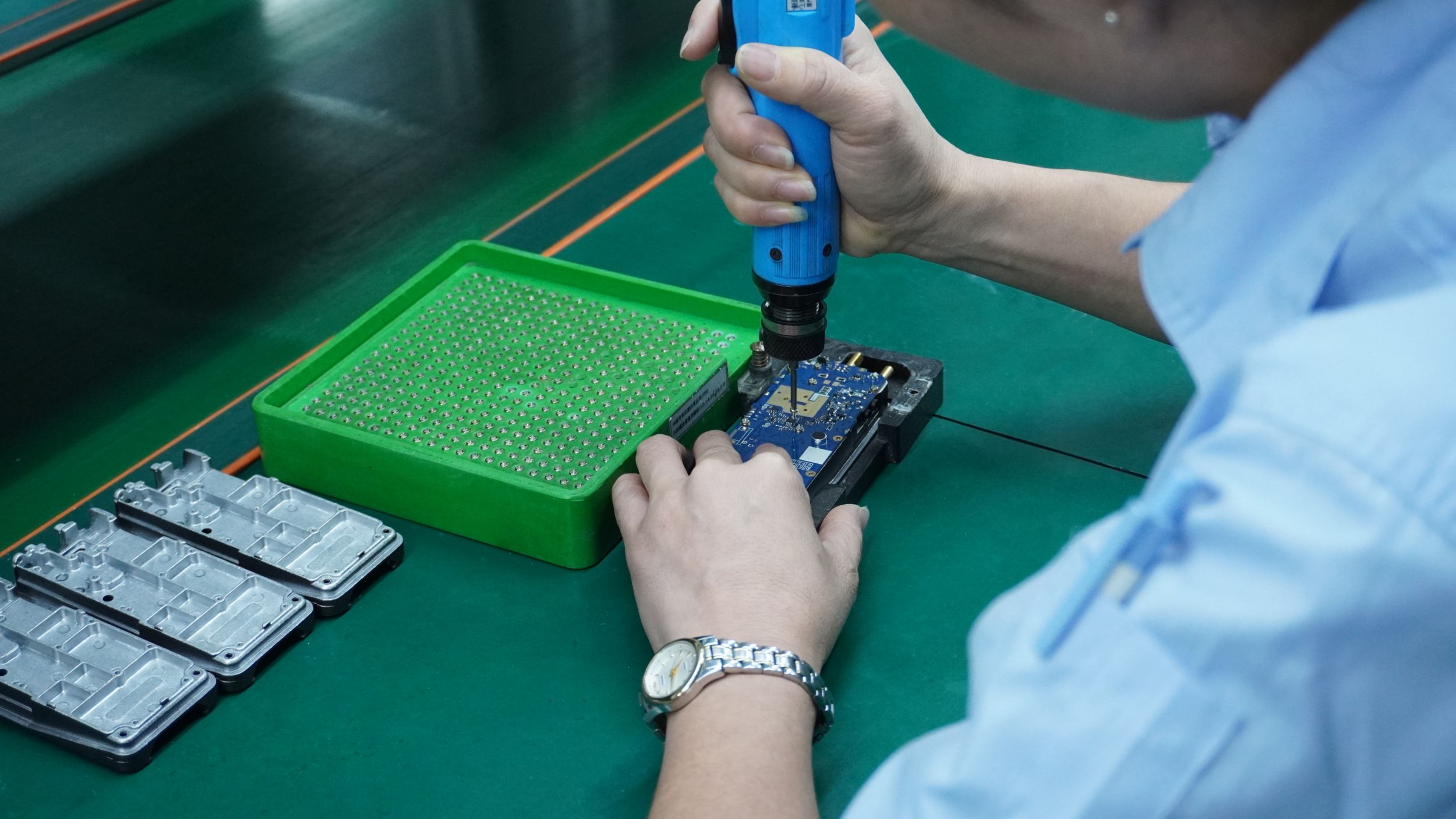
Firmware stability across temperature and interference isn't a single checkbox. On the temperature side, the main risk is clock drift: quartz crystals shift a few parts per million per degree, and that alone can throw off packet timing. This firmware uses a pre-characterized temperature table stored during factory calibration. As the thermistor reading moves, the compensation routine adjusts the external oscillator trim in fine steps rather than waiting for a large error. In thermal chambers cycling between -20°C and 70°C, the measured frequency deviation stayed under 2 ppm, and no link drops were traced to timing loss.
Interference handling takes a different path. Instead of relying on a fixed channel map, the firmware samples noise floor for a few milliseconds before each scheduled transmission. If the channel is congested or a strong adjacent signal appears, it shifts the transmit slot within the agreed time window and shortens the preamble. This keeps packets short enough to slip through gaps in bursty interference. Long-duration tests with a 2.4 GHz jammer sweeping at 10 Hz intervals produced occasional retries, but no firmware resets and no stuck states. The worst-case recovery after a lost ACK was 28 ms.
The real test is when both stressors hit at once. Running at 65°C with an interferer sweeping across the band does not produce additive errors. Temperature compensation and interference avoidance are scheduled on different timer priorities, and the radio state machine treats a missed ACK as a routine path rather than an exception. That design choice means a hot, noisy environment doesn't push the stack into an unrecoverable corner.
Custom Frequency Plans Without the Usual Runaround
Most providers treat frequency planning as a one-size-fits-all checklist. You get handed a generic schedule and told to make it work, even when your equipment, terrain, or operating rhythm clearly needs something different. That friction disappears when the plan is built around your actual usage patterns instead of a default template.
The process starts with a short conversation about what you're actually trying to accomplish. Do you need tighter spacing in one region and more breathing room in another? Are there legacy systems that can't shift without a staged rollout? Those details shape the plan, so you don't end up negotiating exceptions after the fact.
Revisions shouldn't mean starting over. When a frequency plan is built as a living document, small adjustments happen without a new approval cycle or a pile of paperwork. You get a plan that fits the way you work, not the other way around.
Lead Times, MOQs, and Production Planning Realities
Any sourcing conversation that skips over lead times and minimum order quantities is missing the actual constraints that shape a production schedule. A factory might quote eight weeks for a standard reorder, but that number quietly assumes raw materials are already sitting in their warehouse. Once a specialty zipper or a custom-dyed fabric enters the equation, the clock restarts, and suddenly the same product needs twelve or fourteen weeks. MOQs add another layer of friction: the supplier's minimum is often tied to their own upstream purchasing, not to your sell-through rate. So you either tie up cash in excess inventory or negotiate a higher unit price to split the difference.
Production planning gets messier when you factor in regional holidays, equipment maintenance windows, and the simple fact that most factories run multiple clients through the same lines. A planner who only looks at a spreadsheet will assume capacity is linear, but floor supervisors know that a 500-unit order for a simple tote bag behaves nothing like a 500-unit order with three colorways and contrast stitching. The realistic approach is to treat lead time as a range, not a promise, and to build buffer weeks around the operations you cannot control. MOQs then become a negotiation about shared risk, not a fixed rule carved in stone.
What separates smooth launches from constant firefighting is often the willingness to map out the entire chain before placing a purchase order. Ask the supplier what their own component lead times look like, whether they pre-book fabric for repeat styles, and how they handle line changeovers. Those small details rarely show up on a quote sheet, but they determine whether your goods ship in late September or early November. Ignoring them might feel efficient in the short term, but the rework, air freight, and missed shelf dates cost far more than the extra week of planning ever would.
After-Sales Support That Answers Before the Third Email
Most support teams treat email like a game of ping-pong, bouncing the same question back and forth until someone finally digs up the answer. Not here. We read the thread, spot the real problem, and reply with the fix — not another round of 'could you please clarify?'
By the time your first follow-up would normally hit our inbox, the issue is already on its way to being resolved. That’s because we don’t just react to what you wrote; we look at what you didn’t write — the screenshots you forgot to attach, the account details buried in the signature, the error log that tells the whole story.
The goal isn’t to close tickets faster. It’s to make you forget you ever opened one. You send one message, get one clear answer, and get back to building your business. If you ever find yourself typing a third email to ask for an update, something went wrong on our end — and we’ll fix that too.
Learning from Long-Term Deployments in the Field
The first lesson from leaving systems in real environments for months at a time is that lab assumptions rarely hold. Sensors drift, connectors corrode, and users behave in ways the design team never imagined. A robot deployed in a greenhouse, for example, learned that pollen buildup on its lidar could silently degrade navigation accuracy over weeks. These failures don't appear in short trials, only in the slow accumulation of everyday wear.
Long-term deployment also forces a different kind of engineering. Instead of chasing perfect performance on a benchmark, teams start caring about graceful degradation and remote diagnostics. A system that can report its own battery health or flag an unusual motor current saves a site visit. Over time, the most valuable features become those that reduce the need for human intervention, not those that add new capabilities.
Perhaps the most unexpected payoff comes from the data itself. Over months, patterns emerge that are invisible in a two-week pilot. Usage logs show which functions are never touched, which error states repeat at specific temperatures, and how the environment changes with the seasons. These insights feed back into hardware revisions and control algorithms, turning the deployment from a demonstration into a genuine teacher.
FAQ
A genuine manufacturer controls the RF design, firmware, and production line, while a reseller typically white-labels existing modules. You can verify this by asking for schematic-level documentation, firmware update roadmaps, and the ability to modify frequency ranges or power output without waiting for a third party.
Look for regional compliance such as FCC Part 90 for the US market, CE/RED for Europe, and possibly MIL-STD-810G if the radios will be used in harsh environments. Also confirm the manufacturer holds ISO 9001 for quality management and can provide full test reports, not just certificates.
Request a golden sample and run your own field tests across both bands—VHF and UHF—in real-world conditions. Pay attention to adjacent channel rejection, intermodulation rejection, and receiver sensitivity. A trustworthy manufacturer will also share their production test limits, such as TX power deviation and RX sensitivity specification.
Beyond branding, a solid partner should support custom firmware features, tailored frequency bands within legal limits, programmable button functions, encryption protocols, and even hardware modifications like a different antenna connector or battery capacity. Ask whether they handle in-house injection molding and SMT assembly to avoid delays.
Dual band radios require precise impedance matching across two frequency ranges. Low-quality PCB materials or substituted components can cause frequency drift, poor isolation, and reduced sensitivity. A transparent manufacturer will provide a bill of materials with approved vendor lists and may allow you to inspect the factory or audit the supply chain.
Don't just look at unit price. Compare warranty terms, defect rates, firmware update support, and the cost of replacement parts over three to five years. A manufacturer with a lower upfront price but a 5% field failure rate will end up costing far more than one with a 1% rate and responsive after-sales support.
Watch for vague answers about RF testing, reluctance to share production line photos or videos, inability to provide references from similar clients, and pressure to finalize orders without a pilot run. Also be wary if they claim to support any frequency or power level without asking about your target market and licensing requirements.
Yes, a reputable partner will sign detailed NDA and IP assignment agreements before any design work begins. They should also offer separate production runs for your molds and tooling, and be willing to store them exclusively for your orders. Ask about their history with OEM/ODM projects and whether they have ever been involved in IP disputes.
Conclusion
Choosing a dual-band radio manufacturer is not about ticking boxes on a datasheet. It starts with understanding the RF front-end under real operating conditions—receiver sensitivity, selectivity, and intermodulation often look fine on paper, yet fall apart with temperature swings or dense interference. A serious partner will walk you through those measurements and admit where a design struggles. Firmware is equally telling: look for radios that hold frequency accuracy and link stability across heat, cold, and noisy spectrum. Custom frequency plans should not require months of back-and-forth; the right factory has internal tools to shift band edges, channel spacing, or duplex offsets quickly and without excuses.
Production realities matter just as much: lead times, minimum order quantities, and component sourcing plans need to be stated plainly, not hidden until the purchase order. Support after the sale should feel like an extension of the engineering team, replying with useful information before a third follow-up. Finally, ask for references from long-term field deployments—ports, utilities, or rural networks that have run the same hardware for years. Those stories reveal how the manufacturer handles failures, firmware updates, and unexpected interference. A dependable dual-band radio partner proves itself long after the first shipment, not in the first sales call. In short, the right choice depends on evidence from the bench and the field, not glossy brochures.
Contact Us
Contact Person: andrea
Email: [email protected]
Tel/WhatsApp: (+86)13960400802
Website: https://www.lishengradio.com/