

Servo Motor Magnets Supplier You Can Trust for High Torque Applications
2026-09-07
When high torque demands precision, sourcing servo motor magnets becomes a decision that directly impacts performance. DAWA focuses on supplying magnets that hold up under demanding motion control requirements, not just meeting specs but ensuring consistency where it matters most. This post explores what to look for in a supplier you can actually trust.
Magnetic Materials That Deliver Torque Without Demagnetizing
The ability of a magnetic material to transmit torque without losing its magnetization hinges on its coercivity and the shape of its demagnetization curve. In high-load applications such as electric vehicle traction motors or industrial servo drives, magnets are subjected to strong opposing fields generated by stator currents. Materials with a linear second-quadrant B-H characteristic, like neodymium-iron-boron grades with heavy rare-earth additions, hold their flux density nearly constant as the external field rises, which means the rotor can deliver predictable torque even under overload conditions.
Beyond composition, the geometry and orientation of the magnet play decisive roles. Segmenting a rotor into multiple poles with magnets magnetized in a near-radial direction reduces local demagnetizing fields at the edges. Meanwhile, adding dysprosium or terbium at grain boundaries elevates the intrinsic coercivity enough to survive brief fault currents without irreversible loss. This design philosophy lets engineers push torque density higher while keeping the permanent magnets well away from the knee of the demagnetization curve.
Thermal management also cannot be ignored. As temperature climbs, coercivity drops, and a magnet that is stable at 80°C may start to demagnetize at 150°C if the working point drifts too close to the knee. Therefore, selecting a grade with a high operating temperature rating and pairing it with forced-air or liquid cooling extends the safe torque envelope. The result is a magnetic circuit that delivers smooth, sustained torque through thousands of load cycles without measurable demagnetization.
How Magnet Shape and Orientation Impact Servo Response
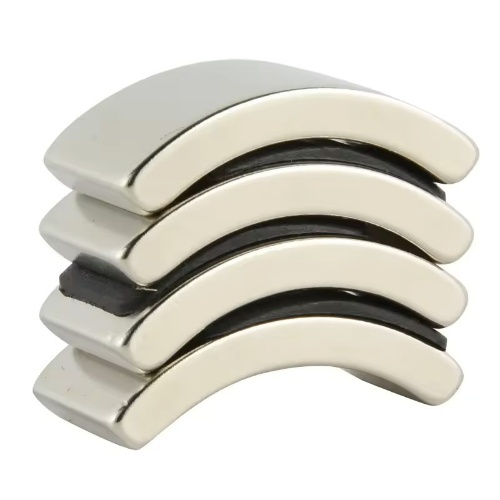
Magnet shape controls how flux crosses the air gap before it ever reaches the windings. Arc-segment magnets with a close fit to the stator bore spread flux more evenly, reducing the sharp transitions that cause cogging torque. Block or rectangular magnets concentrate flux at the magnet edges, which can raise peak torque but also introduce low-speed velocity ripple. For servo applications where smooth tracking matters more than raw torque, a tapered or skewed magnet profile often yields cleaner back-EMF waveforms and less audible noise during constant-speed moves.
Orientation errors are just as disruptive as shape choices. A radial orientation through the magnet thickness keeps the d-axis aligned with the pole center, but even a few degrees of angular misalignment shifts the torque constant and creates cross-coupling between the current loops. Halbach arrays and segmented axial orientations reduce leakage flux without increasing rotor inertia, which is critical when the servo must reverse direction quickly. In practice, matching the magnet orientation to the encoder resolution prevents limit cycle oscillation at standstill, while a shape that lowers cogging amplitude shortens settling time after each commanded step.
Keeping Performance Steady as Temperatures Climb
Heat is often the quiet enemy of consistent output. As ambient temperatures rise, components throttle, fluids thin, and tolerances shift in ways that don't always trigger an alarm. Instead of chasing a single cooling upgrade, start by mapping where thermal bottlenecks actually appear under sustained load. A cheap temperature strip on a motor housing or an infrared spot check near a power supply can reveal hotspots that a room-level thermostat never sees. Fix those localized issues first, and the whole system holds its rhythm longer.
Preemptive scheduling matters as much as hardware. Move demanding batches to cooler parts of the day, stagger high-draw equipment so they are not peaking together, and build short recovery windows into long runs. These adjustments keep junction temperatures below the point where protection circuits begin cutting power or processors dial back clock speeds. In many setups, a ten-minute pause every two hours costs far less than the performance loss from running hot for an entire shift.
Watch for drift, not just failure. A machine can keep running while accuracy slowly degrades, and the first sign is often a subtle rise in rejected parts or a lag in response time. Pair temperature logs with output quality data. When a few degrees of heat correlate with more variance, act early: adjust airflow, change coolant viscosity, or resequence loads. That kind of small, evidence-based correction keeps performance steady long before a hard thermal shutdown forces a stop.
Custom Magnet Prototypes That Fit Unusual Rotor Designs
Off-the-shelf magnet arcs rarely follow the true contour of an unusual rotor. Custom prototypes let you match asymmetrical pole shapes, stepped radii, or embedded pockets instead of forcing the rotor to accept a generic curve. This matters most when flux density needs to stay uniform across a non-circular air gap, or when mechanical retention depends on the magnet hugging a complex pocket wall.
The practical route starts with a clean CAD model of the rotor stack, then moves to machined or near-net sintered blanks that get finish-ground to the required profile. Small prototype batches make it possible to measure back EMF, cogging torque, and thermal drift before any production tooling is cut. Tolerances on the magnet's arc and thickness often need to be tighter than standard catalog parts, especially if the rotor runs at high speed.
Material choice should follow the operating environment, not just the datasheet. High-temperature or high-vibration rotors often call for samarium cobalt or high-coercivity neodymium grades with appropriate coatings, while bonded magnets can be pressed into net-shape forms that eliminate secondary machining. A prototype supplier that handles mixed compositions and quick re-machining cycles tends to save more time than one with a large but inflexible catalog.
Batch Consistency Checks That Prevent Torque Drift
Torque drift in fastened assemblies often goes unnoticed until joints loosen or components fail. It rarely stems from a single dramatic event, but from small inconsistencies that accumulate across a production batch. Batch consistency checks address this by comparing torque behavior across samples from the same lot, rather than treating each fastening as an isolated event. When a subset of units shows a slight downward trend in achieved torque under identical conditions, it signals a drift that individual pass/fail tests would miss.
Practical prevention relies on routine sampling and statistical tracking of torque values. For example, recording the mean and range of torque readings from every fiftieth unit allows engineers to spot a gradual shift before it crosses the specification limit. Calibration drift in torque tools, changes in thread friction due to coating variation, or even temperature shifts on the line can all be caught this way. The key is to act on the batch-level pattern—adjusting tool settings, re-lubricating fasteners, or re-qualifying a supplier—rather than waiting for out-of-tolerance parts to appear. This turns a potential field failure into a controlled adjustment on the shop floor.
Lead Times and Logistics You Can Actually Plan Around
Reliable lead times start with honest math, not marketing promises. We quote in working days, not calendar days, and we add buffer only where it makes sense—customs clearance, holiday backlogs, or the occasional carrier delay that every supply chain hits sooner or later.
You’ll get a shipping window you can actually use for planning, plus live tracking that updates at the milestones that matter: order confirmation, departure, port arrival, and final-mile handoff. If something slips, we tell you before it becomes your problem.
FAQ
Torque depends on the magnet's remanence, coercivity, and the magnetic circuit design. We supply grades like N42SH and N48H with tight tolerances so the air gap flux stays predictable, which directly supports higher torque without oversizing the motor.
Yes, we offer samarium cobalt and high-temperature neodymium grades rated up to 200°C continuous. Each batch includes thermal demagnetization curves so you can verify performance under load before committing to a design.
We machine magnets to tolerances as tight as ±0.02 mm and use automated optical inspection on every piece. This keeps rotor balance stable and reduces vibration at speeds above 10,000 rpm.
Our engineers review your torque-speed curve, operating temperature, and space constraints, then recommend specific grades and coating options. We often provide FEA simulation files for the magnetic circuit before you order prototypes.
For most servo applications we suggest nickel-copper-nickel plating or epoxy coating. For harsh conditions, like marine or chemical exposure, we can apply parylene or aluminum chromate conversion coating to prevent oxidation and extend magnet life.
Every batch goes through BH curve tracing, flux density measurement, and salt spray testing when coatings are involved. We keep lot-specific records for five years, so you can trace any performance shift back to raw material or process changes.
Prototype quantities usually ship within 10 to 15 business days after drawing approval. Full production runs take 4 to 6 weeks depending on grade and coating complexity, but we can hold safety stock for repeat orders to cut that down to under a week.
Yes, our flexible manufacturing lines handle orders from a few hundred pieces for pilot builds up to millions per year for mass production. Tooling costs are waived for long-term supply agreements, which helps you scale without changing suppliers.
Conclusion
When pushing servo motors into high torque territory, the magnet is where everything either holds or fails. A dependable supplier starts with material selection—grades like N42SH or N48H neodymium or samarium cobalt that maintain flux density under load instead of quietly demagnetizing after repeated current spikes. Beyond chemistry, the geometry matters just as much. Arc segment thickness, chamfer angles, and magnetization direction have a direct effect on cogging and response time, so a supplier that tweaks these details for your rotor profile gives you a motor that reacts instantly rather than fighting its own field. Temperature stability is another silent killer. Motors running hot need magnets rated for continuous operation at 150°C or higher, otherwise torque fades when you need it most. That kind of selection doesn't happen by accident; it comes from vendors who treat every parameter as part of a working system, not a parts catalog.
The real trust gets tested when your rotor design doesn't fit a standard mold. Custom prototypes should arrive quickly, machined or wire-cut to match unusual lamination shapes, and then tested under your actual load profile before full production. Batch consistency is what keeps torque from drifting between orders. A supplier that checks remanence, coercivity, and dimensional variance on every lot—and shares those reports with you—prevents the slow degradation that shows up as a motor that feels weaker six months later. Finally, lead times need to be honest. Instead of vague promises, you get clear schedules that account for magnetizing fixtures, coating, and shipping, so your assembly line never sits idle waiting for magnets that were supposed to come from a 'reliable' source. That's what a supplier worth trusting looks like: they understand the whole motor, not just the magnet.
Contact Us
Contact Person: Kelvin Lo
Email: [email protected]
Tel/WhatsApp: 0769-88561131
Website: https://dawamagnetic.com/