

Stainless Steel Hex Bolts Manufacturer Insights for Durable Fastening Solutions
2026-09-30
When your project demands more than off-the-shelf reliability, the choice of fastening hardware becomes a quiet determinant of success. Stainless steel hex bolts—with their blend of tensile strength and corrosion resistance—form the backbone of durable assemblies in marine, chemical, and structural applications. Yet not all manufacturers understand the subtle interplay of alloy composition, thread tolerance, and surface finish. That's where Wanluo stands apart: a dedicated stainless steel hex bolts manufacturer turning material science and production know-how into fastening solutions built to hold. In this post, we explore the insights that separate a trusted supplier from a risky compromise.
Alloy Selection Beyond the 304 Default for Matching Bolt Grades to Actual Service Conditions
The habit of reaching for 304 stainless bolts whenever a corrosion-resistant fastener is specified ignores how quickly that alloy loses its grip in chloride-heavy or elevated-temperature settings. A better starting point is to compare the actual exposure—moisture, pH, salt mist, process chemicals, thermal cycling—against the pitting and crevice corrosion thresholds of candidate grades. For mildly aggressive washdown areas, 316 with its molybdenum addition already outperforms 304 without complicating procurement. But in marine atmospheres or brackish water, moving to duplex 2205 or super duplex 2507 often eliminates the hidden maintenance burden of premature thread galling and pitting, even though initial unit cost rises.
Mechanical strength adds a second filter that chemical compatibility alone cannot satisfy. Standard 304 and 316 bolts conforming to ASTM A193 B8 or B8M are strain-hardened but still fall short of the load capacity offered by precipitation-hardening grades such as 17-4 PH (A564 Type 630) or cold-worked duplex. In structural joints subject to vibration or cyclic tension, selecting a bolt simply because it will not rust can lead to fatigue cracks long before the material shows visible corrosion. Matching the code-required tensile and yield values to the clamp load, not just swapping in a “stainless” part, prevents this mismatch from surfacing after installation.
Sour service, cryogenic conditions, and high-temperature oxidation introduce further constraints that make the 304 default untenable. Hydrogen sulfide exposure demands martensitic or duplex alloys with controlled hardness and compliance to NACE MR0175/ISO 15156, while sub-zero operations favor austenitic grades retaining toughness below -100°C. Bolts used in furnace or exhaust environments above 500°C may require A453 Grade 660 or nickel-based alloys to resist relaxation. Each of these conditions pushes the selection logic away from a one-size-fits-all stainless designation and toward a deliberate pairing of alloy chemistry, heat treatment, and fastener geometry with the specific environment the joint will actually endure.
What Precision Thread Rolling Reveals About a Manufacturer's Process Control
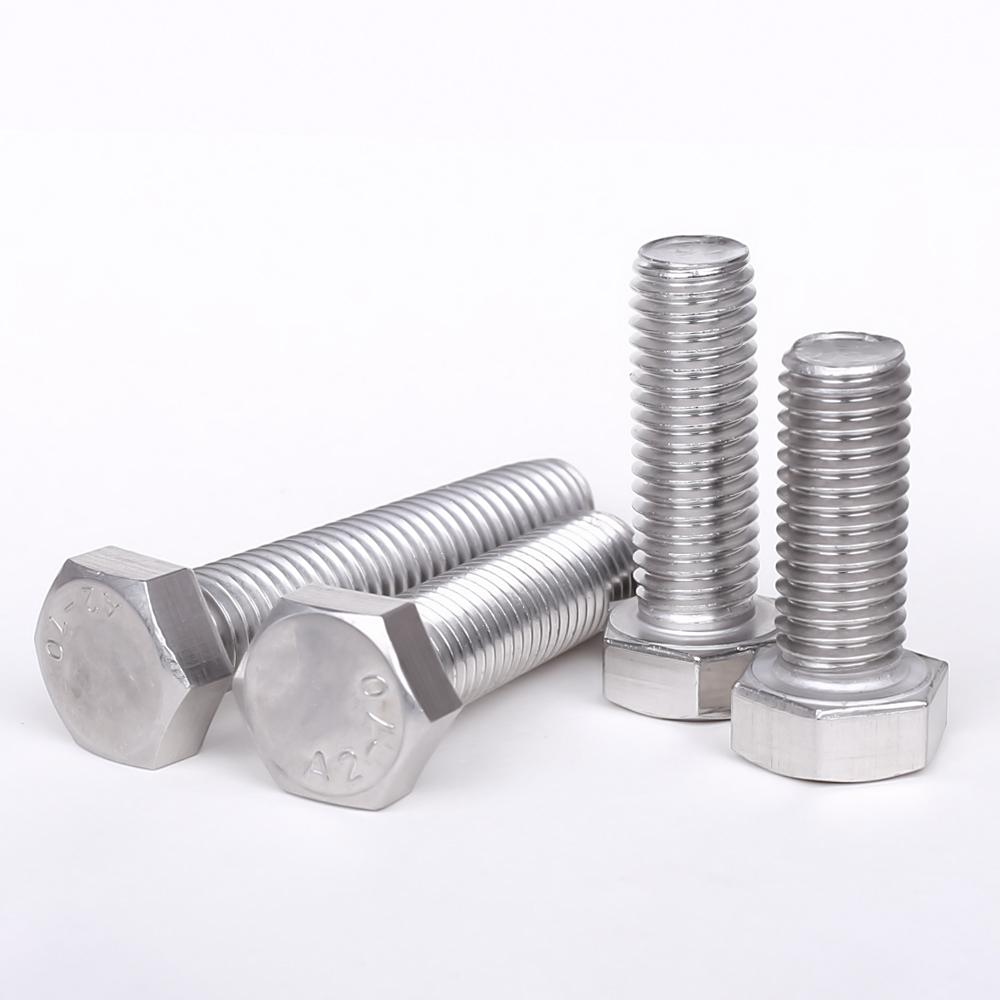
Precision thread rolling isn't just about producing accurate threads; it exposes how tightly a shop controls its upstream variables. Because the process displaces metal rather than cutting it, any drift in blank diameter, material hardness, or die condition shows up almost immediately as thread form errors or dimensional scatter. A manufacturer that holds a consistent class 3A or 3B thread across thousands of parts is demonstrating control over incoming stock, tooling setup, and machine rigidity—not just running a final inspection.
The cold-working nature of rolling magnifies subtle changes. If the wire or bar stock varies slightly in tensile strength from one heat lot to the next, the rolling pressure will change and the pitch diameter will shift. Shops that rely solely on post-process gauging often catch these shifts late, after a batch of nonconforming parts has already been produced. In contrast, those with in-process monitoring of rolling torque or die load can spot the drift early and adjust tooling or sort incoming material before it becomes a quality problem.
Die wear is another honest signal. Thread rolling dies wear at a predictable rate when the process is stable, but accelerated or uneven wear points to misalignment, improper lubrication, or excessive material hardness. A manufacturer that tracks die life per job and correlates it with thread profile measurements gains a clear view of its process capability. The thread itself becomes a record of how well the entire upstream chain—from raw material to tool maintenance—is being managed.
Why Stainless Steel Still Needs Proper Passivation Despite the Corrosion Myth
Many people assume stainless steel is completely rust-proof, but that's a misunderstanding. Its corrosion resistance comes from a thin, passive chromium oxide film that forms naturally. However, manufacturing processes like cutting, welding, or grinding can embed free iron and other contaminants into the surface, disrupting this protective layer. Without proper passivation, these microscopic defects become starting points for rust.
Passivation is not about adding a coating; it's a chemical treatment that removes surface iron and enhances the chromium oxide layer. By bathing the metal in an acid solution, typically nitric or citric acid, you dissolve free iron and allow a thicker, more uniform oxide film to form. This step is especially critical after fabrication, because heat tint and weld scale can deplete chromium near the surface, leaving those areas vulnerable.
Even high-grade alloys like 316 can corrode in harsh environments—chlorides, low oxygen, or crevices can break down the passive layer. Skipping passivation doesn't guarantee immediate failure, but it shortens the service life and invites pitting or staining. For applications where hygiene, structural integrity, or appearance matter, passivation is cheap insurance against the myth that stainless steel maintains itself.
Load Distribution and the Underappreciated Role of the Washer Face
Most engineers treat the washer as little more than a spacer or a cheap way to protect a surface, but that flat ring of metal does something far more subtle: it rewrites how force travels through a joint. When a bolt is tightened, the load doesn't simply shoot straight down the shank. It radiates outward and then gets funneled back through the threads, the head, and ultimately the bearing surface. The washer face sits right at that critical interface, and its flatness, hardness, and even the microscopic texture of its surface dictate whether the clamping load spreads evenly or crowds into a few narrow high-pressure spots.
A washer with a slightly imperfect face can completely alter the joint's behavior without anyone noticing until it fails. If the face isn't parallel to the nut or bolt head, the initial tightening torque goes into bending the fastener or locally crushing the mating material rather than building reliable preload. Over time, vibration or thermal cycling works those tiny contact points loose. On the other hand, a carefully finished washer face creates a more uniform pressure cone under the head, which means the same torque produces a more predictable clamp load and reduces the risk of embedding or relaxation in softer substrates.
The real payoff shows up in high-cycle fatigue and critical sealing applications. A well-controlled washer face reduces the bending stress that gets superimposed on the bolt's axial stress, which is often the silent killer of fasteners in engines, flanges, and structural connections. It's not glamorous, but paying attention to that thin annular contact zone can extend joint life by orders of magnitude. The washer face doesn't just sit there; it actively shapes the load path and decides whether the connection stays tight or slowly works itself apart.
Batch Traceability as a Marker of Reliable Hex Bolt Supply
A hex bolt that carries a clear batch or lot number tells you more than its dimensions. That identifier links the fastener back to the specific heat of steel, the production run, and the surface treatment applied. When one bolt out of ten thousand fails, the difference between a minor replacement and a full line audit often comes down to whether you can trace that single piece back to its source and isolate every other bolt from the same batch.
Reliable supply chains treat traceability as a physical practice, not just a certificate in a folder. The batch number stamped on the head or printed on the sealed bag should match the mill test report and the plating log without gaps. Suppliers who cannot produce lot-specific documentation on request, or who offer only generic compliance statements, are really asking you to take their word for the steel’s origin and heat treatment. That ambiguity is where counterfeit or mixed-grade fasteners slip into inventory.
For buyers, batch traceability also changes how problems get resolved. A recalled shipment can be quarantined by batch rather than by broad date range, saving time and avoiding unnecessary scrap. Auditors and insurers look more favorably on records that show a complete chain from raw material to delivery. Testing a supplier’s traceability claim is straightforward: ask for the full history of one recent batch, including raw material certificates, in-process inspection notes, and final packaging records. A dependable source will provide them without hesitation.
Common Field Failures That Trace Back to Installation Torque Rather Than Material Defects
Quite a few field failures get blamed on bad material, but the real culprit is often the wrench work on the front end. When a bolt is over-torqued, it can yield plastically before it ever sees a service load. That leaves the joint with less clamping force than intended, and it opens the door to fatigue cracks near the thread roots or under the head. Over-tightened gaskets crush and lose resilience, so flanges start weeping weeks or months later even though the gasket material passed every lab test. On the flip side, under-torqued fasteners allow micro-movement at the mating surfaces. That fretting wears away protective coatings, invites corrosion, and eventually the nut backs off or the bolt snaps from cyclic bending.
The torque wrench itself is part of the problem. Most installation torque specs assume a narrow range of friction between threads and under the bearing face, but in the field that friction can vary by 20 to 30 percent depending on surface condition, plating, and whether the assembler used anti-seize or threadlocker. The same torque reading can produce wildly different preloads. Multi-bolt patterns add another layer of trouble: if you run down one flange bolt all the way before the others, the gasket takes an uneven set that never fully recovers. A lot of “material defects” reported from the field turn out, after teardown, to be classic symptoms of poor torque control — brinelled washers, galled threads, and fracture surfaces that show low-cycle fatigue from an under-clamped joint rather than inclusions or heat-treat problems in the steel.
FAQ
Stainless hex bolts rely on the chromium oxide layer for self-healing corrosion resistance rather than a thin sacrificial coating. Once zinc plating gets scratched, the underlying carbon steel rusts quickly, while stainless keeps its integrity even with minor surface damage. For marine or chemical exposure, that difference alone often justifies the higher upfront cost.
Ask for full material test reports, not just a generic spec sheet. A reliable manufacturer will provide heat lot traceability, proof load test data, and hardness readings that line up with ISO 3506 or ASTM F593. If they hesitate to share those documents, treat that as a warning sign regardless of the price.
Galling is common with stainless fasteners because the passive oxide layer can tear under high friction, causing micro-welds between the male and female threads. Slower installation speed, anti-seize lubricant, and slightly different hardness levels between bolt and nut reduce the risk. It is not a defect; it is a material behavior that needs the right assembly practice.
Look at how they handle lot consistency, surface finish, and secondary operations like passivation or thread rolling. A manufacturer that controls the entire cold heading process in-house tends to produce fewer dimensional deviations. Also check whether they offer custom packaging or kitting if your assembly line wants ready-to-use batches.
Not always. A2 is fine for general outdoor use away from chlorides, but A4 contains molybdenum and handles salt spray, coastal air, and mild chemical exposure much better. Swapping A2 into a marine or de-icing salt environment can lead to premature staining and pitting even though the bolt still looks intact.
Cold heading works the metal at room temperature, aligning the grain flow along the bolt’s contours instead of cutting through it. That gives better fatigue resistance and a tougher head-to-shank transition. Machined bolts can be precise, but they lose some of that continuous grain structure, which matters in vibration-heavy applications.
Passivation removes free iron and other surface contaminants, allowing the chromium oxide layer to form evenly. Without it, embedded steel particles from tooling or handling can create tiny rust spots even on 304 or 316 material. The bolt may still function, but passivation gives a cleaner, more uniform corrosion barrier from day one.
Yes, experienced manufacturers often provide torque recommendations, thread tolerance adjustments, and pre-applied lubricants to match your specific joint design. That upstream support cuts down on cross-threading, galling, and inconsistent clamp load, which are far more common causes of field failure than raw material defects.
Conclusion
Stainless steel hex bolts rarely fail because the alloy itself is weak; more often the wrong grade was chosen for the actual service environment. While 304 remains a default, chloride exposure, elevated temperatures, or cyclic loading may demand 316, duplex, or even precipitation-hardening grades. A manufacturer that asks about the application before quoting is already doing more than most. Precision thread rolling offers a window into that manufacturer’s process control—consistent pitch diameter, smooth root radii, and absence of laps indicate disciplined tooling maintenance, not just a good batch. Passivation still matters for stainless, despite the myth that it is naturally rustproof. A properly passivated surface removes free iron and restores the passive oxide layer, which is what actually prevents pitting in the field. The washer face is another underappreciated detail: a flat, perpendicular bearing surface distributes clamp load evenly, reducing the risk of loosening or fatigue cracking at the underhead radius.
Beyond the part itself, batch traceability separates dependable suppliers from transactional vendors. If a manufacturer cannot tie a lot of hex bolts back to its raw material heat, its thread rolling setup, and its passivation records, then any future field issue becomes guesswork. Field failures happen, but they are frequently traced to installation torque rather than material defects. Over-tightening can yield the shank or strip threads; under-tightening leads to joint slip and premature loosening. Good manufacturers publish torque guidance based on friction conditions and surface finish, and they treat that guidance as part of the product—not an afterthought. Durable fastening is rarely about one heroic material property. It is the accumulation of proper grade selection, controlled thread forming, clean passivation, smart bearing geometry, and honest traceability, all supported by realistic installation practice.
Contact Us
Contact Person: Shane
Email: [email protected]
Tel/WhatsApp: 8613357785029
Website: https://www.wanluohardware.com

