

Top European-Type Substation Solutions for Modern Energy Infrastructure
2026-11-16
European-type substations are no longer just an equipment choice; they are a strategic piece of modern energy infrastructure. Yet the gap between a generic enclosure and a truly field-ready solution shows up in thermal performance, corrosion resistance, operational safety, and ease of expansion. This article looks at what leading options get right—and where Lugao fits into the shift toward leaner, more resilient grid assets.
Why Space-Starved European Grids Are Moving to Gas-Insulated Compact Bays
In cities like Amsterdam and Milan, the search for switchgear space often ends in basements, tunnels, or slivers of land between buildings that were never meant to hold high-voltage equipment. Air-insulated bays eat up too much room, and expanding a substation outward is rarely an option when every square metre is contested. Gas-insulated compact bays change that arithmetic. By enclosing busbars, breakers, and disconnectors in sealed, gas-filled compartments, they shrink clearances from metres to centimetres and allow the same switching function to fit into a fraction of the floor area.
The appeal is not only physical. Utilities in dense European grids are also dealing with rising fault currents, tighter network security requirements, and the need to connect renewables without waiting years for new corridors. A compact GIS bay can be slotted into an existing building, placed underground, or hidden behind a facade without disrupting the neighbourhood. That makes permitting less painful and keeps projects moving even where traditional open yards would trigger years of objections.
Maintenance patterns matter too. Sealed gas compartments keep moisture, dust, and salt out, which reduces the slow degradation that plagues exposed contacts in coastal or humid areas. Crews inspect less often, and outages become shorter because the modular layout lets operators isolate one bay without taking the whole board out of service. For a continent where much of the urban grid was built decades ago, that combination of small footprint, lower upkeep, and faster installation is turning compact bays from an expensive niche into a practical default.
IEC 62271 Testing Turned into a Design Advantage, Not a Checklist
Engineers often treat IEC 62271 as a gate to pass at the end of a project, running tests only when the switchgear design is already frozen. That habit turns the standard into a backward-looking checklist. The moment testing shifts into the early design loop, it starts shaping decisions about contact geometry, insulation margins, and busbar stiffness instead of simply ratifying them. Short-circuit withstand becomes a prompt to revisit mechanical bracing, while temperature-rise data nudges ventilation and conductor cross-sections before the first prototype is built.
In practice, this means the sequence changes. Rather than discovering during type tests that a joint runs too hot, designers use preliminary current injection to map thermal bottlenecks and adjust clamping pressure or plating thickness while changes are still cheap. Dielectric tests on partial assemblies reveal field stress concentrations that can be fixed by altering shield profiles, not by adding margin after the fact. The standard remains the referee, but the real work happens upstream, where each requirement is read as a design input rather than a pass/fail line.
The result is a product that carries its compliance more naturally. A panel that has been shaped by IEC 62271 from the beginning tends to have cleaner internal clearances, more balanced forces under fault, and fewer late-stage compromises. Customers rarely see the testing history, but they feel it in how quietly the breaker operates, how cool the enclosure stays, and how little drama appears in the service record. That is the difference between ticking a box and letting the standard do real engineering work.
Modular Busbar Architecture for Unpredictable Renewable Feed-In
Renewable feed-in rarely behaves like a steady synchronous generator. A clear morning can push a solar field from a few hundred kilowatts to full output in the time it takes to change a shift, while wind ramps can linger near zero for days and then spike. A modular busbar architecture accepts that unpredictability by breaking the connection backbone into discrete, repeatable segments that can be mixed, extended, or isolated without reworking the entire assembly. Instead of locking a site into a single calculated ampacity, the design lets the electrical spine follow the project’s actual output patterns and staged capacity.
The difference is most obvious during expansion or fault response. If a developer adds another inverter block or replaces older string inverters with higher-current units, the busbar can be extended in place rather than requiring a wholesale shutdown. A single module can be de-energized, inspected, or swapped while other sections continue carrying power. The approach shortens downtime and removes the pressure to overbuild the original busbar on day one. Engineers can buy the copper they need now and add matching segments when actual production data justifies it.
Fault management also improves because each module creates a natural boundary. When output becomes erratic due to cloud edges, voltage dips, or inverter nuisance trips, thermographers and maintenance crews can scan from joint to joint and narrow the problem to a specific segment. A loose connection or a hot spot no longer means tracing a long monolithic bar; it means isolating one clearly defined section. Over the life of a plant, that kind of diagnostic clarity can matter more than the initial price difference.
Noise, Sealing, and Fire Safety in Underground Urban Substations
Transformer hum and cooling fan noise rarely stay inside the equipment bay. In an underground substation, vibration finds a path through structural steel, cable supports, and even the concrete shell, turning nearby lobbies or apartments into unintended sounding boards. Addressing this starts at the source—low-noise fans, tighter core clamping, and resilient mounts—but it also requires breaking the transmission chain with floating floors, wall linings, and acoustic seals around every penetration. Where residual noise remains, active masking or tuned absorbers can pull the background level down without making the space feel clinical.
Sealing below grade is less about keeping a room tidy and more about controlling what moves through the building envelope. Water, fire gases, and humid air all follow the same weaknesses: cable penetrations, pipe entries, expansion joints. A layered approach works better than a single product. Hydrophilic strips and intumescent collars can be paired so that one swells on contact with water and the other expands under heat, leaving no unsealed path. Attention has to extend to the smallest ducts and inspection openings, because pressure differences between the substation and the host building will push air through any gap that is left open.
Fire safety in these buried facilities is shaped by limited escape routes and the presence of oil-filled equipment. The strategy usually combines early detection with local suppression that does not drown critical switchgear. Aspirating smoke detection can pick up incipient overheating before flames develop, while water mist or inert gas systems cool and starve a fire without the collateral damage of deluge. Just as important are the passive measures: fire-rated walls, self-closing doors, and smoke control that keeps exit corridors tenable long enough for a controlled shutdown and evacuation.
Making Legacy Distribution Panels Accept Storage Without a Rebuild
Older distribution panels usually have plenty of breaker spaces but nowhere near the bus rating or fault-current margin that a modern storage system expects. One practical workaround is a line-side tap ahead of the main breaker, placed in a separate enclosure. This lets the battery connect through its own fused disconnect without asking the legacy bus to carry more current or interrupting the existing feeder layout.
If the original gear still has factory support, a subfeed lug kit or a double-lug main can create a dedicated path for storage while leaving the existing branch sections untouched. Where that is not available, a small wall-mounted fused disconnect between the old panel and the inverter keeps the existing equipment within its rated limits. The main thing is to show the inspector that the new feeder is protected independently, so the age of the panel does not become the reason to replace it.
Relay Coordination When Grid Inertia Keeps Dropping
Protection engineers used to assume that fault current would arrive with a certain stiffness: synchronous machines would hold voltage and feed a short circuit long enough for time-overcurrent curves to do their work. As inertia keeps falling, that assumption gets thinner. Rotor angles swing faster after a disturbance, and the magnitude and direction of fault current can shift within the time a relay needs to declare a fault. A coordination pair that works on paper may fail in the field simply because the underlying fault signature no longer stays put for the expected duration.
The practical consequences show up in ways that look like miscoordination even when the settings have not changed. A downstream relay may see a lower, faster-decaying current and delay tripping, while an upstream backup element sees just enough to start timing and overtakes it. Directional elements can also become harder to trust when frequency is moving quickly and voltage phase angles are no longer anchored by large rotating masses. Instead of adding more time margin, which makes the system less secure, protection groups are moving toward shorter grading intervals, adaptive pickup thresholds, and logic that re-evaluates the fault current trajectory rather than relying on a single steady-state value.
Relay coordination in a low-inertia environment becomes less about fixed curves and more about matching protection response to the actual rate of change. That can mean using rate-of-change-of-frequency or voltage phase movement as an input to adjust trip timing, or pushing more functions onto communications-assisted schemes that do not depend on delayed remote backup. It also means testing relays against low-inertia fault cases where current collapses quickly or swings through an unexpected angle. The grid is moving faster, and the protection philosophy has to move with it.
FAQ
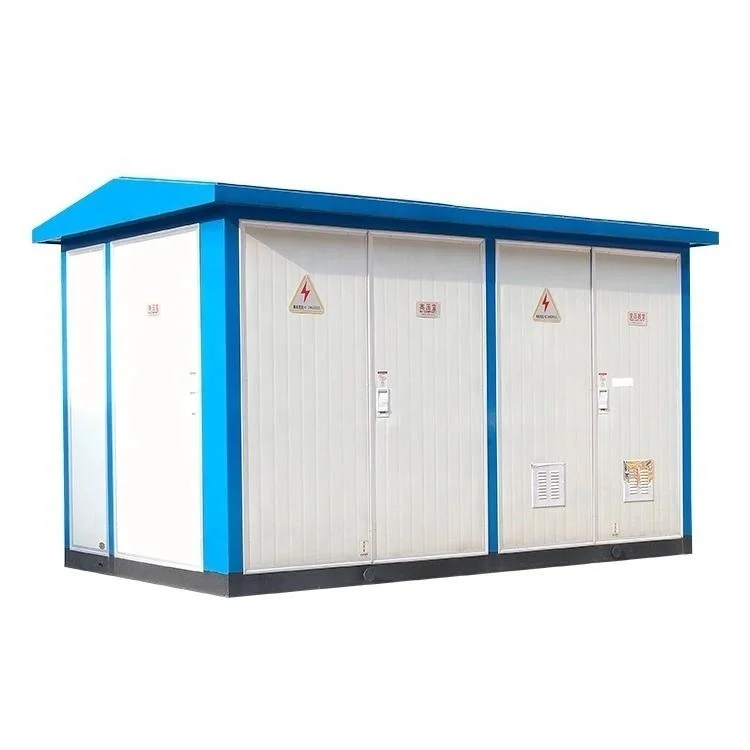
A European-type unit usually arrives as a compact, factory-assembled enclosure with separate compartments for medium-voltage switchgear, transformer, and low-voltage distribution. Unlike sprawling outdoor yards, it prioritizes a smaller footprint, internal arc containment, and finishes that fit into urban or industrial settings without looking like heavy infrastructure.
Most designs cover medium-voltage distribution from roughly 6 kV to 36 kV, though some configurations extend into lower high-voltage ranges for specific utility or industrial needs. The exact rating depends on grid conditions, short-circuit levels, and whether the unit serves a renewable plant, a municipal network, or a private consumer.
They often include switchgear layouts and protection schemes that handle bidirectional power flow, making them suitable for solar farms, wind parks, and battery storage connections. Because they are compact and pre-tested, they can be placed close to generation sites without the delays and land requirements of conventional substation construction.
Yes, many are built with corrosion-resistant enclosures, sealed cable entries, and climate control systems that manage condensation and temperature swings. Higher protection ratings and materials such as stainless steel or coated aluminum help them withstand salt spray, dust, humidity, and extreme weather far better than standard open-air installations.
Internal arc containment, separated compartments for different voltage levels, pressure relief ducts, and mechanical interlocks are common. These measures reduce risk during operation and maintenance, and they allow the equipment to be installed closer to populated areas, public buildings, or sensitive industrial processes.
Because most components are enclosed and factory-tested before delivery, routine work focuses on inspection, filter cleaning, contact checks, and thermal monitoring. The modular construction also means a faulty panel or transformer cell can often be replaced without shutting down or dismantling the entire installation.
Yes. Urban projects frequently call for low-noise transformers, custom cladding or paint, reduced height, and ventilation tailored to confined spaces. Underground or semi-underground versions are also available with waterproof enclosures, remote monitoring, and access arrangements designed for limited clearance.
Beyond the initial price, it is worth checking type-test certifications, internal arc classification, enclosure corrosion class, expected service life under local conditions, ease of cable termination, and the manufacturer's ability to provide long-term spare parts and local support. These factors often determine whether a unit remains cost-effective over twenty or thirty years.
Conclusion
European distribution networks are being reshaped less by grand redesigns than by a series of tightly focused hardware and protection choices. In dense urban areas, gas-insulated compact bays are replacing air-insulated layouts because they recover valuable floor space while holding up under high fault duty. Manufacturers now treat IEC 62271 not as a final hurdle but as an early design input, using its temperature rise, short-circuit, and internal arc requirements to refine bushing placement and enclosure strength before prototypes are locked. At the same time, modular busbar arrangements allow utilities to connect and disconnect feeder positions without long outages, which matters when solar and wind injections shift seasonally and even hourly.
Underground installations add another layer of constraints. Noise limits, gasket aging, and fire containment are being engineered together rather than handled as separate add-ons, with pressure relief directed away from walkways and ventilation sized for slow-burning faults. Older distribution panels are also being retrofitted with storage interfaces by reusing spare busbar taps and adding compact DC/AC blocks, avoiding the cost of a full switchgear rebuild. Finally, protection schemes are moving toward faster, more selective relay settings because declining synchronous inertia means fault currents no longer behave as predictably as they once did. The result is a set of European-style solutions that favor smaller footprints, tougher enclosures, and more flexible protection over oversized one-size-fits-all substation designs.
Contact Us
Contact Person: Doreen
Email: [email protected]
Tel/WhatsApp: 8618057712366
Website: https://www.liugaopower.com/