

Wheel Heat Exchanger Factory: A Behind-the-Scenes Look at Precision Engineering
2026-11-16
Walk through any wheel heat exchanger factory and you'll hear the same promise: precision. Few deliver it the way ROTER does. From laser-aligned rotors to hand-checked tolerances, this behind-the-scenes look reveals why a thermal wheel is only as good as the obsession behind its build.
Raw Stock, First Inspection
Raw stock arrives in a raw, unpolished state, straight from the supplier. The first inspection is about looking past the obvious and checking the material's actual condition before any cutting or shaping begins. We check for surface defects, dimensional accuracy, and any signs of stress or corrosion that might have happened in transit. This step isn't about fancy equipment or lengthy reports—it's mostly a visual and tactile pass, running hands over edges, checking thickness with a simple gauge, and comparing against the purchase spec.
What often surprises people is how much variation can hide in a batch that looks uniform at a glance. Sometimes a single sheet or bar has a subtle bow, a hairline crack near an end, or a hardened spot from uneven cooling at the mill. The first inspection is where we catch those before they become a problem downstream. It's not unusual to reject a few pieces and set them aside for return or rework. The goal is to make sure every part that moves to the next stage starts from a known, reliable baseline.
We don't rely on a strict checklist printed from a template. Instead, the inspector's experience guides what gets looked at more closely—maybe the edges on cold-rolled stock, or the flatness on a plate that will be welded. This keeps the process fluid and honest, with notes written in plain language and photos taken only when something unusual shows up. It's a quiet but critical gate that saves time and material later on.
When Tolerances Get Personal
When tolerances move from engineering drawings into human relationships, they stop being about millimeters and start being about how much of another person's behavior we can absorb before friction appears. Each of us carries an invisible tolerance band, and once someone crosses it, a habit that was once harmless becomes a point of quiet irritation. This shift rarely happens all at once; it builds with repetition and stress until we realize we have been measuring someone else's every move.
Making tolerance personal means accepting that we are not fixed machines. Our patience fluctuates with mood, energy, and context. What we laughed off yesterday may feel unbearable today. The challenge is not to set a rigid standard but to recognize our current limits and communicate them honestly, rather than pretending to have endless capacity until we snap.
Oddly enough, when we start respecting our own personal tolerances, we also get better at reading other people's signals. We stop treating differences as flaws and start seeing them as different operating ranges. This perspective reduces unnecessary conflict because it reframes "you are wrong" into "we are currently in different tolerance zones." In the end, that might be one definition of maturity: learning to adjust your own tolerance while accepting that someone else's is just as real.
Welding Cells That Never Blink
In a factory where sparks fly like iron rain, the welding cell performs with a rhythm that feels almost human—yet it never pauses to wipe its brow or flex a cramping hand. Each torch movement follows a path burned into memory through thousands of repetitions, but the path never drifts, and the arc never wavers. The cell doesn't know fatigue, doesn't get distracted by a shift change or a ringing phone. It simply welds, again and again, with the same heat, the same angle, the same silent stare.
What looks like tireless automation is actually a studied patience. The cell watches every seam through sensors that read temperature, gap, and wire feed in real time, adjusting in milliseconds before a flaw can form. A human welder might trust instinct after years on the floor; this machine trusts data—but the result is the same: a bead so consistent you could lay a straightedge against it. The difference is the cell does this at 3 a.m. on a holiday weekend without a single blink.
That’s the quiet revolution hiding in plain sight on the production line. Welding cells that never blink don’t just speed up output—they change what quality means. They eliminate the tiny variations that come from a tired wrist or a second-guessed setting. And while they can’t admire their own work, the parts they leave behind speak a language of precision that needs no sleep.
The Calibration Room's Silent Judgment
The room does not speak, yet its verdict arrives with the weight of a held breath. Instruments line the walls in mute expectancy, their dials frozen at zero, their cables coiled like patient snakes. Nothing moves except the slow drift of dust in the light above the calibration plate. Whoever enters here leaves conversation at the door; the only language that matters is the one written in micro-ohms and arc-seconds, a grammar too fine for the human ear.
Judgment comes not as a voice but as a shift in the needle's hesitation, a digital readout that settles after the third decimal place. There is no appeal, no argument, no chance to explain why the measurement drifted. The machine simply compares what is to what should be, and the room's silence sharpens until it feels like a blade. If the numbers align, the lock clicks open and you are released into the ordinary world. If they do not, the silence remains, asking you to try again with steadier hands.
Over time, people attribute a personality to this impartial space. They say the room remembers every failed attempt, that it stores them in the faint scratches on its steel table. But the truth is simpler and colder: the calibration room has no memory and no malice. It simply waits, utterly indifferent, for the moment when your trembling, hopeful adjustment either meets the standard or falls short. That stillness is the judgment itself.
Balancing Rotors to the Gram
Most rotor balancing jobs come down to a gram here or a gram there. The frustrating part is that a part can sit perfectly still on a set of level knife edges and still vibrate like a paint shaker once it gets up to speed. That’s because static balance only tells half the story.
To get a rotor balanced to the gram, you need to work in two planes, not just one. A dynamic balancer measures both the amount and the angle of the heavy spot, then you correct it by drilling, grinding, or adding weight. It’s iterative: spin, read, adjust, repeat. The better the machine, the fewer trips back to the drill press.
The payoff is hard to see until you run a well-balanced rotor next to one that’s off by a few grams. The smooth one hums along and keeps its bearings cool. The other gnaws at everything around it. At higher RPM, even a two-gram error can turn into a constant, unwanted side load that shortens the life of seals and shafts.
Where a Wheel Heat Exchanger Earns Its Name
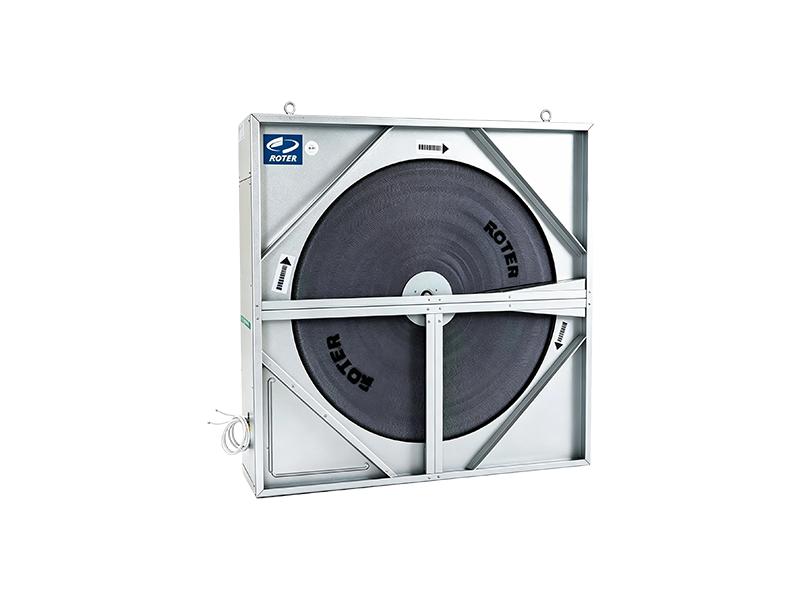
The name isn't a metaphor or a clever bit of marketing—it comes straight from the machine's most visible moving part. Inside the casing, a large rotor, often coated with a desiccant or made from corrugated metal, spins slowly between two airstreams. One side of the wheel absorbs heat from the exhaust air; as it turns into the supply stream, that stored thermal energy is released. The wheel itself is the exchanger, rotating to carry heat from one place to another without the two airflows ever mixing.
What makes the design so distinctive is that the heat transfer surface is in constant motion. Unlike a plate exchanger, where static walls separate the streams, here the medium literally rolls through both environments. That rotation is why the word 'wheel' sits front and center—people watching it operate immediately understand the principle. The heat doesn't flow through a fixed barrier; it rides along on a spinning mass, continuously cycling between warm and cold zones. It's a mechanical loop that turns thermal recovery into something you can watch.
FAQ
The core difference is the rotating matrix, a honeycomb-like wheel that continuously cycles between hot and cold gas streams. Instead of fixed plates, this design lets the same surface alternate between absorbing and releasing heat, which is why you'll see it in HVAC systems and industrial heat recovery where gas-to-gas exchange has to happen in a compact footprint.
Most of the critical machining happens in a temperature-controlled bay because even a few degrees of thermal expansion can throw off seal gaps. The team uses CNC lathes and laser alignment rigs to keep runout within a few microns, then hand-checks the hub and rim fit before the wheel is balanced.
It starts with slitting and forming the foil or polymer media into a corrugated profile, then winding or stacking it into a cylindrical matrix. After that, the hub and spokes are machined, the matrix is bonded or brazed, and the whole assembly goes through dynamic balancing and a leak test before final packaging.
Aluminum foil is common for sensible heat recovery because it's light and conductive, while desiccant-coated media shows up when humidity transfer matters. In corrosive exhaust streams, you might see stainless steel or polymer cores instead. The material choice directly affects thermal efficiency, pressure drop, and how long the wheel survives in the field.
They rely on a mix of automated optical inspection and dye penetrant testing on brazed joints. Vibration sensors during spin testing pick up imbalance that would be invisible as a visual flaw. If a wheel doesn't pass the dynamic balance threshold, it's stripped down and rebuilt rather than patched.
Honestly, the quiet precision. Despite large sheets of metal moving through, the area around the balancing machines is almost silent because every roller and bearing is tuned to eliminate chatter. Also, a surprising amount of work is still done by hand, like trimming the media edges with guided blades to avoid micro-tears that automated cutters can cause.
It's a constant trade-off between making the foil thin enough to transfer heat quickly and thick enough to survive years of rotation and thermal cycling. They often use finite element models to find weak spots, then reinforce only the rim and hub areas while keeping the media itself as light as possible.
Conclusion
Step inside the wheel heat exchanger factory and the first thing that strikes you is how quiet precision can be. Raw stock arrives and gets inspected not once, but with an obsessive eye for surface finish and alloy consistency—because any flaw here compounds into a rotor that wears unevenly. Machinists talk about tolerances the way others discuss the weather: a few microns off on a bore, and the entire thermal path shifts. The welding cells, operating with unblinking robotic arms, lay down seams so uniform they disappear into the parent metal. Yet it's the calibration room that sets this place apart—a climate-controlled space where gauges are checked against master standards, and a single drift of two thousandths of a millimeter triggers a full re-verification of every instrument on the floor.
Then comes balancing. Each finished rotor is mounted on a dynamic balancer and spun to operating speed, with correction weights added to the gram. Not because the customer will ever see them, but because an unbalanced wheel heat exchanger doesn't just vibrate—it loses efficiency, stresses bearings, and shortens its own life. That final step—balancing rotors to the gram—is where the machine earns its name: a component that must transfer heat while spinning at high speed, sealed against leakage, and enduring thermal cycles for years. The factory floor doesn't shout about its craftsmanship. It simply measures, welds, checks, and balances, over and over, until every wheel heat exchanger that leaves the dock is as close to flawless as human and machine can make it.
Contact Us
Contact Person: Rhea
Email: [email protected]
Tel/WhatsApp: +8618800560886
Website: https://www.rotorairtech.com